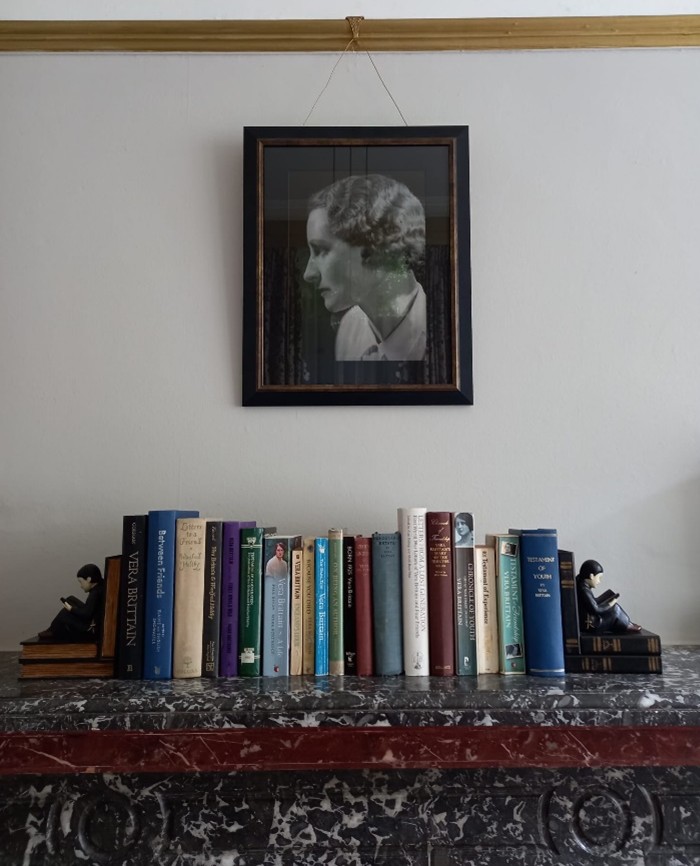
Some books by Vera and about Vera on the mantlepiece
in what was the Brittains’ dining room at Melrose, their
Buxton home between 1907 and 1911.
The portrait is by Howard Coster,
taken in 1936 (National Portrait Gallery)
| AMBITIONS TO BE A WRITER Vera said ‘as soon as I could hold a pen I started to write, and before that I told stories to my brother’. By the time she was 11, she had written five ‘novels,’ illustrated with pencil drawings. Some of the qualities of her juvenile fiction would later emerge in her five published novels, idealistic and moralistic, infused with references to religion and death and featuring noble, independent, self-sacrificing heroines. Her own reading at school and afterwards endorsed such tendencies. She enjoyed George Eliot, Wordsworth and Arnold Bennett; George Eliot in particular became a lifelong influence on Vera’s ideas about fiction. School also introduced Vera to the work of the suffragettes, notably South African feminist writer Olive Schreiner. In 1911, Vera began to keep a ‘reflective record’. There is no record for 1912 but from 1913 to 1917, she charted in great detail events, feelings about the people she knew, and mused at length on religious ideas, marriage, love, education and her ‘grand passions’ for people she admired. She also noted ideas for novels and until 1917, wrote about her nursing experiences and, at moving length, about her anguish and fears during the war. Vera also wrote poetry, and her first major publication was Verses of a V.A.D. (1918). Throughout the 1920s, Vera was a successful and prolific freelance journalist (link to Vera in London page) In 1933, she published Testament of Youth. Since the end of the war, Vera had made some attempts to use her diary and letters as a basis for a novel about youth betrayed into cynical disillusionment, and all the grief, struggle and loss her generation had suffered. She did not make much progress (two provisional titles were abandoned; The Incidental Adam and This Was Their War) before finally deciding in 1929 to write a memoir (see Bostridge 2014, p115-123 for discussion of Vera’s discarded drafts). By the late 1920s, a shift in public perception of the First World War created a market for memoirs about direct experience of the war, such as Robert Graves’s Good-Bye to All That: An Autobiography (1929) and the acclaimed play by R.C. Sherrif, Journey’s End in 1929. Vera read and reviewed some of them for Time and Tide. She decided her story was as interesting as those of Edward Blunden, Siegfried Sasson and Graves. Telling friends ‘I am writing the sort of book no-one has written before’, she wanted to put women’s experience of war at the heart of the memoir, and to commemorate the deaths of the men she loved. Her skilful interweaving of history, heartfelt personal experience and political standpoint changed the genre of autobiography. She wanted, she said, to ‘make my story as truthful as history but as readable as fiction’. Although Testament of Youth has never been out of print, interest in it dwindled from the 1940s. By the time Vera died in 1970, she believed she had been forgotten but hoped a new generation might discover its relevance. She could not have predicted just how successful it was to become. FEMINIST FICTION IN THE 1920S AND 1930s Whilst at Somerville in 1915, Vera met Dorothy L. Sayers and at university after the war in 1919, Vera and Winifred met others who would become their literary contemporaries Hilda Reid, Margaret Kennedy and Sylvia Thompson. Fuelled by an increased sense of freedom brought about by university, war, education and suffrage, more women became professional writers in the 1920s and 1930s than at any time in British history. A booming new market for middlebrow, socially aware fiction was encouraged by ‘circulating libraries’, especially in the provinces; Boots, for example, had 400 libraries, with over half a million subscribers eager for the latest titles. In 1925, 25 million books were exchanged; by 1939, it was 35 million. Vera and Winifred were members of a circle of left-leaning, feminist writers which included Storm Jameson, E.M. Delafield, Phyllis Bentley and Rebecca West. This network shared ideas for plots and characters, recommended agents and publishers, and reviewed each other’s books in magazines and journals such as Time and Tide where Winifred and E.M Delafield were both directors. Eschewing the modernist experimentation and interest in characters’ inner lives favoured by writers such as Virginia Woolf, a leading member of the Bloomsbury circle, and more traditional novels favoured by the Hampstead circle which included H.G. Wells, Vera’s literary circle hoped to change people’s ideas about social and political matters, Evolving from a strand in late Victorian fiction in which ‘new women’ struggled to throw off middle-class expectations to become free spirits, popular plots in the autobiographical novels of Vera and her literary circle saw women escape from an oppressive provincial life to university or London or, if escape was not possible, coping by subverting expectations of marriage and domesticity (e.g. Winifred Holtby’s The Crowded Street. Sometimes a protagonist returned to the provinces as an emancipated social reformer (see Winifred Holtby’s South Riding. And presaging so much women’s fiction today, a recurring theme was women’s struggle towards empowerment and self-definition, to take, as Vera put it, ‘your life in your own hands and live it’. Another theme was, as Vera put it about Winifred Holtby’s The Crowded Street, ‘the search ‘by the burdened, frustrated soul for some magic experience lying just beyond the confines of daily life’ (for overview of women’s fiction between the wars see Nicola Beauman’s A Very Great Profession: The Woman’s Novel 1914-1939. VERA’S NOVELS Vera thought good writing could engage readers who might not be interested in the issues she cared about if she presented them more seriously. In the light of the trauma inflicted on her generation by the First World War, Vera believed that writers had to interpret the unprecedented, confusing and complicated times they lived in. A characteristic of all Vera’s novels was, as she said in her foreword to Testament of Youth, “to put the life of an ordinary individual into its niche in contemporary history.” She also wanted her plots and characters to convey moral and historical insight, and promote a commitment to social change. Despite wanting to be a critically acclaimed and popular novelist, Vera’s novels were not nearly as successful as Testament of Youth. When her memoir was republished by Virago Press in 1978, its huge success encouraged Virago to re-issue three of Vera’s five novels (The Dark Tide, Born 1925 and Honourable Estate) in the early 1980s, together with some of Winifred’s: while Winifred’s are still in print, Vera’s are not. Admirers argue that although Vera did not achieve her deeply held ambition, her novels are eminently worthy of being read and revalued in our time. Critics at the time they were first published and today point to her over-reliance on an autobiographical approach, and tendencies to wordiness, simplistic, stereotyped and under-written characters and proselytising social and political messages. Some contemporary readers dislike Vera’s didactic, rather ‘preachy’ tone. The Dark Tide The Dark Tide was rejected by several publishers before Grant Richards brought it out in 1923 (for which Vera had to contribute £50 towards publication costs). It garnered some good reviews and also attracted the attention of the political scientist George Gordon Catlin, who Vera married in 1925. Vera had made notes for the novel after returning to study at Somerville in 1919. The protagonist, Virginia Dennison, is based on her. Her unflattering depiction of life in a women’s college and characters whose originals were easily identifiable led to great criticism in Oxford. It was criticised for a melodramatic plot and characters. Some of Vera and Winifred’s women friends disliked her very unflattering depiction of the character of Daphne Lethbridge, who was based on Winifred, in contrast to the rather egoistical portray of Virginia. Fans today like its period setting for the theme of women’s right to independence and self-fulfilment, and the intriguing counter-theme, Vera’s belief in self-sacrifice for the cause of duty. Not Without Honour Caricature and melodrama also characterise Vera’s ‘Buxton story’ in which she drew on experiences and people in Buxton, including her parents, herself (as Christine Merrivale) and acquaintances. She also used long verbatim passages from her 1913 and 1914 diary. Set in the Edwardian health resort of Torborough, the novel presages the anti-provincial, feminist narrative Vera went on to use in Testament of Youth. After leaving a progressive boarding school in the south of England, attractive, spirited, intellectually accomplished, dissatisfied Christine Merrivale rebels against her wealthy, conservative parents, a claustrophobic home life, censorious society matrons, pompous young men whose single ambition is to follow their fathers into business, and a pointless existence as a ‘provincial debutante’ . Christine falls in love with Albert Clark, a charismatic Anglican curate whose unorthodox views, popularity with his working-class parishioners and belief in Christian socialism cause great controversy in the town. Clark is based on Reverend Joseph Ward with whom Vera formed an intense friendship, and whose inspiring sermons she recorded verbatim in her diary. Refusing to leave his wife, Clark is killed on the western front; Christine learns of his death at Oxford, where she is finding her way to independence, self-fulfilment and maturity. At Oxford, Christine meets Virginia Dennison, the protagonist of The Dark Tide based on Vera. Honourable Estate Published in 1936, Vera hoped this inter-generational feminist saga would establish her as a serious, accomplished author of fiction. It is Vera’s longest, most ambitious novel. Despite criticisms of wordiness, overemphasis, and earnestness, it was a best-seller in both Britain and the United States. Today many judge Honourable Estate to be Vera’s best and most important novel but it has not stood the test of time: after being republished by Virago Press in the 1980s, it is again out of print. The foreword tells readers that the novel ‘purports to show how the women’s revolution — one of the greatest in all history — united with the struggle for other democratic ideals and the cataclysm of the war to alter the private destinies of individuals.’ The story’s three marriages convey the changing social position of women from the Victorian era to the 1930s. Its title refers to the marriage service and ‘stands for that position and respect for which the world’s women and the world’s workers have striven’ and for ‘that maturity of the spirit which comes through suffering and experience.’ Vera cast herself as Ruth Allendyne in Honourable Estate and used characters from her father’s and her husband Gordon Catlin’s families. She drew on the diaries of Edith Catlin, her husband’s mother, especially Edith’s revelations about her unhappy marriage to a dogmatic, domineering Congregational minister from whom she ran away in 1915, abandoning her young son. Edith worked for women’s suffrage until her death two years later. In Honourable Estate, Denis Rutherston, the abandoned son, is based on Gordon Catlin. As with earlier novels, Vera used First World War experiences, including her discovery in 1934 that her brother Edward had homosexual relationships with men in his platoon and, facing the prospect of court martial, had possibly made sure he was killed in Italy by Austrian snipers in July 1918. Vera also drew on her unrequited feelings for her American publisher George Brett, and her fraught, short-lived friendship in 1932 with best-selling Yorkshire novelist, Phyllis Bentley. Ruth Alleyndene’s brother Richard is based on Edward, while the glamorous American officer Eugene Meury, who has a doomed affair with Ruth, is inspired by George Brett and Roland Leighton, while the successful, influential playwright Gertrude Ellison Campbell is based on Phyllis Bentley. Account Rendered In 1944, Vera’s novel Account Rendered drew on personal experience and observation, and her pacifism. It allowed Vera to demonstrate the destructive impact of war on mind and spirit. Biographical rather than autobiographical, it arose from her real-life role as a potential witness for the defence of a sensitive, intelligent professional man who had caused his wife’s death and then attempted suicide. He claimed afterwards he could remember nothing. Tracing his amnesia to a bomb explosion in 1918, a team of psychologists found him ‘guilty but insane’. The novel incorporated Ruth Allendyne from Honourable Estate who, in this novel, is now a Labour Member of Parliament. Published first in the United States, Account Rendered received some negative reviews, notably for its pacifist propaganda. Vera believed that political hostility lay behind its negative reception. It was more successful in Britain, selling out its first run of 50,000 copies before publication and received better reviews. Born 1925 Vera’s final novel was published in 1948. Its protagonist, Robert Carbury, and much of the plot, were inspired by the character and life of Dick Shephard, the Anglican priest who founded the Peace Pledge Union and inspired Vera to become an absolute pacifist in 1936. Sheppard died before war broke out in 1939. In Vera’s novel, Robert Carbury, awarded a Victoria Cross in the First World War, is a priest dedicated to the preservation of peace. Like Honourable Estate, it is a generational novel in which, through Carbury’s children Adrian and Josephine, based on Vera’s children John and Shirley, Vera set out to demonstrate changes brought about by the Second World War. Born 1925 sold well in England but while it was respectfully received by critics, it was not the triumph Vera had been hoping for. She regretted her poor literary success, telling her daughter she wished she could be a successful writer of plays and good novels. In her final decades, Vera turned to other genres, including biographies, historical work and political reports and a final memoir, Testament of Experience, published in 1957. See here for Biography and Sources. | ||