As a young woman, Vera’s often felt alienated from her peers, longed for real friendship and had a propensity for intense infatuations, what she referred to as ‘G.Ps’ – ‘grand passions’. These traits would last all her life, and in Buxton, they led to bouts of acute loneliness.
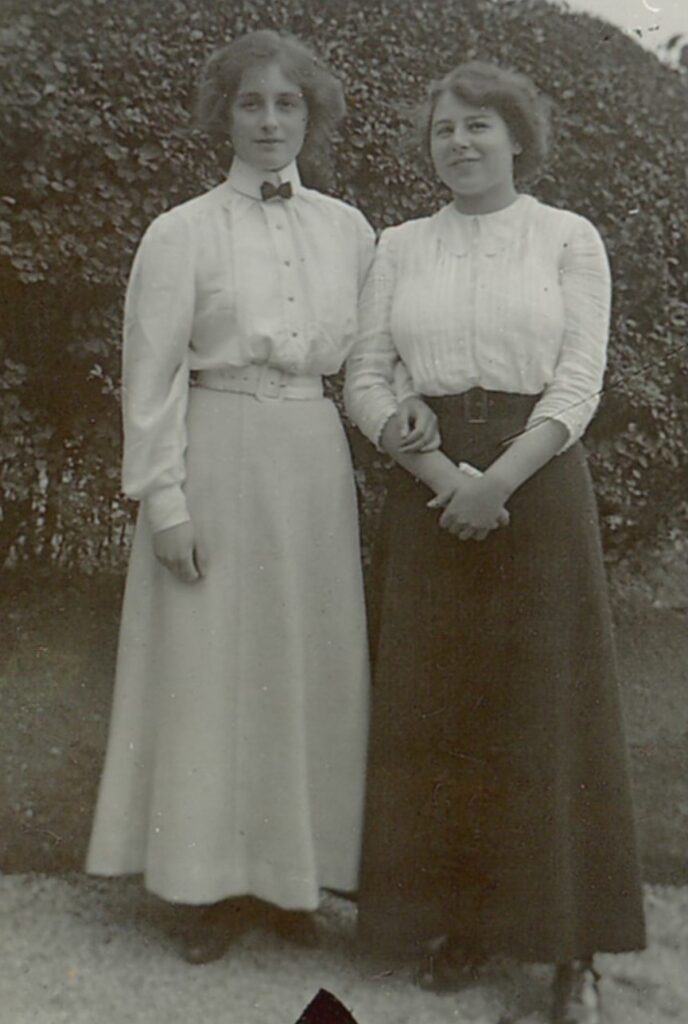
Vera and Cora Stoop, St Monica’s school, c1910 (McM)
When it came to friendship or just getting on with people socially, Vera knew from an early age that she stirred up very mixed reactions. At boarding school between 1907 and 1911, she formed two intense friendships with Cora Stoop, the daughter of an extremely wealthy Dutch-Scottish family, and Stella Sharp who was also from a wealthy family and would later be presented at court. She would later lose touch with Cora and although she nursed with Stella in London and Malta during the First World War, it seems she didn’t stay in contact with Stella after the war.
Having no friends when she moved to Buxton, and making none at her preparatory school the Grange, Vera’s relationships with Cora and Stella were loving but fraught. Vera swung between anxiety about whether they still loved her, and defiance about the merits of being independent, whatever the drawbacks might be. She reflected in her diary that she tended to divide opinion between those who ‘hate me’ and those who have ‘violent adorations for me’, adding ‘there was very little of that half-way house of ordinary popularity’. Her bravado and determination to be self-sufficient belied periods of deep insecurity and hyper-sensitivity. She recognised the ‘mental qualities’ that made her seek solitude even though it made her lonely, and resolved that solitude was ‘a source of strength’. Nonetheless, she yearned for friendship, writing in her diary ‘If only I had someone to really love & be friendly with what a different place Buxton would be!’
Vera’s lifelong difficulties in finding someone she could truly relate to were not helped by her tendency to be dismissive of women. She noted in her diary and to Roland that she did not like women very much and preferred the company of men. At the same time, Vera had a strong sense of what sort of woman she wanted to be. At school and in Buxton, she admired older women who combined femininity with strength of character and aspirations for independence.
Once at Oxford in 1914, Vera enjoyed socialising but made no close friends, reflecting that she had her customary effect of making people like or loathe her and that although she was much discussed and regarded as impressive, she was also often seen as ‘hard’ and ‘conceited’.
It wasn’t until 1919 when she resumed her studies at Somerville after the war, that Vera met Winifred Holtby, the woman who would become her greatest friend and who, Vera said, ‘gave me my second life’.
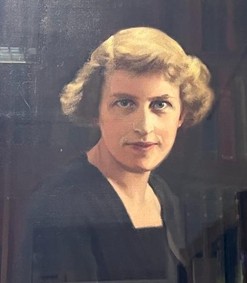
Winifred Holtby, 1936, painted from a photograph,
by Frederick Howard Lewis, (SC)
After the war, the youthful traits which Vera herself knew inhibited her from being close to people, especially women, were supplemented with hyper-sensitivity and feelings of inadequacy about her provincial background. In the highly competitive atmosphere of London literary circles, Vera also feared that she might be seen as a ‘social pusher’ rather than just intellectually ambitious. She desperately wanted the approval of writers like Cicely Hamilton, a suffragette playwright who had founded the women writers’ suffrage league in 1908, and others such as E.M. Delafield, Rebecca West and Rose Macaulay. She was very insecure, describing herself to Winifred in 1921 as an ‘egoistical little poseuse’ who ‘feels petty and parochial and conventional … bragging impotently about unimportant things’. As a bolster against Vera’s insecurities, Winifred was an indispensable source of professional and emotional support. Offering Vera infinite love and encouragement, her death in 1935 at the age of just 37, was a devasting blow.
Vera’s youthful propensity for occasional ‘grand passions’ manifested itself in 1932 in a brief, rather torturous obsession with the successful Yorkshire author Phyllis Bentley.
In the late 1930s and into the 1940s, Vera’s brave and controversial ‘absolute pacifism’ led to difficulties with former friends such as the writer Storm Jameson. After Winifred died in 1935, Vera did not form another close friendship.